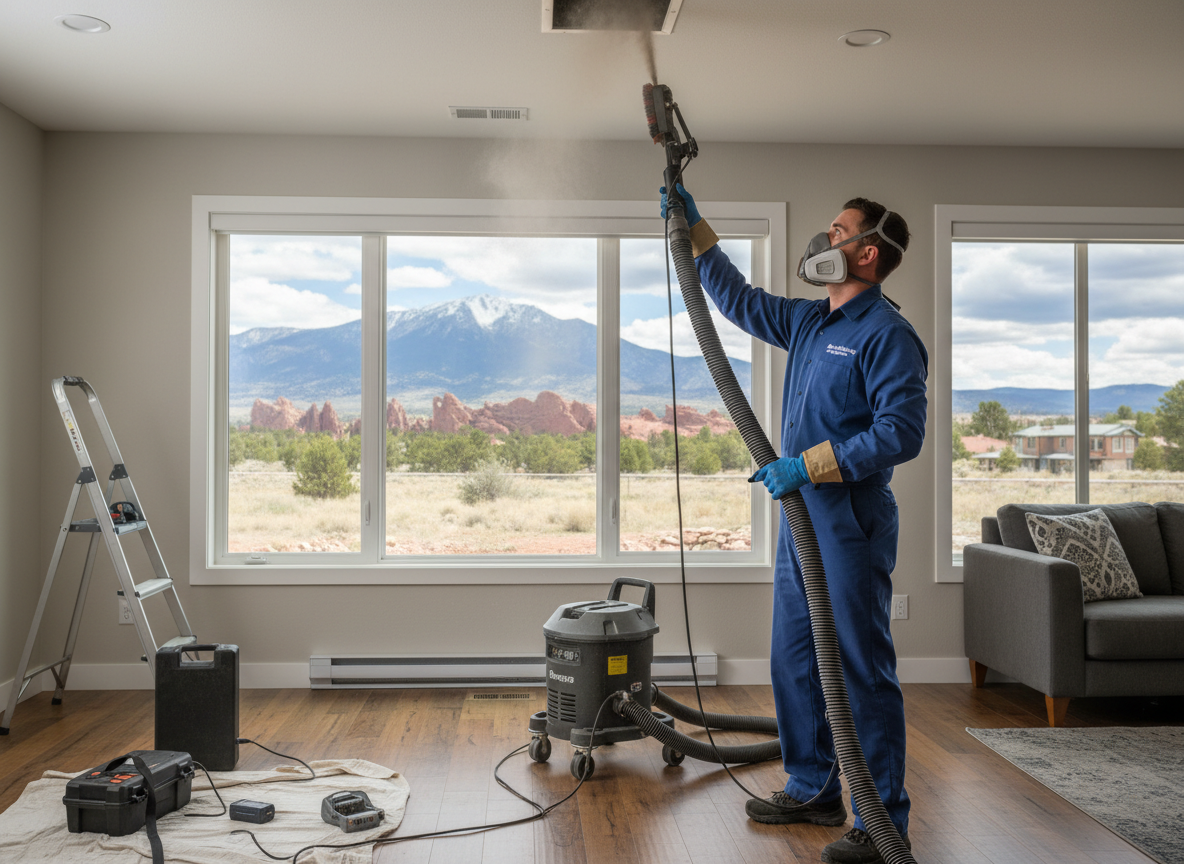
Colorado Springs sits in a semi-arid high-plains climate where hot summers and cold winters drive heavy furnace use from October through April. Homes in Old Colorado City and Manitou Springs often feature older ductwork with accumulated construction dust and pollen from nearby Garden of the Gods slopes. These conditions create persistent fine-particle loads that standard filter changes miss. Our indoor air quality work focuses on source removal inside the ducts rather than masking odors or relying on portable units that cannot reach the full system.
In Broadmoor and Rockrimmon neighborhoods, newer construction still contends with wind-blown silt from the high plains and occasional smoke from controlled burns on Cheyenne Mountain. Furnace filters load faster here than in lower-elevation areas like Pueblo. We inspect for gaps at takeoffs and return plenums that allow unfiltered air to bypass the media, a common issue when homes sit on sloped lots. Addressing these points improves whole-house filtration without requiring new equipment.
El Paso County homes near the United States Air Force Academy and Olympic Training Center frequently experience rapid temperature swings that cause duct expansion and contraction. This movement loosens joints over time and allows attic dust to enter living spaces. Our process includes mapping each run before cleaning, then verifying static pressure afterward so homeowners know the system is moving air efficiently once the job is complete.
Technician insight
In Colorado Springs, the thing that catches most people out with Indoor Air Quality Services is how quickly fine silt from the high-plains wind loads return ducts during cold snaps. Homes in Old Colorado City with original metal ductwork on unconditioned crawlspaces pull that dust straight into the living space every time the furnace kicks on. We see the same pattern in Fountain and Security-Widefield where newer builds still have unsealed takeoffs that standard filter changes never touch.
Broadmoor Furnace Return Blockage
A homeowner in Broadmoor noticed musty air each morning when the furnace ran. We mapped the returns and found heavy dust buildup where the main trunk crossed an uninsulated attic space. After negative-air cleaning and sealing two loose joints, static pressure dropped and the morning odor disappeared.
How it works
- 1
Initial System Mapping
We walk the home from attic to crawlspace, noting duct material, insulation condition, and any visible gaps at registers in neighborhoods like Briargate or Security-Widefield.
- 2
Source Removal
Negative-air machines and rotary brushes reach inside supply and return runs to pull out fine dust and pollen that settles during long heating seasons.
- 3
Filter and Seal Check
We test filter fit and seal any obvious bypass points at the air handler so unfiltered air stops entering the living space.
- 4
Post-Job Verification
Static pressure readings confirm airflow has improved and that the cleaned system is moving air without added restriction.
Pricing
Upfront quotes based on square footage, number of runs, and access conditions in older or multi-level homes.